Slant Diagonals
Slant Diagonals gives every square of a grid one job: hold a single diagonal line. Small circled clues sit where grid lines cross and give the number of diagonals touching that point, and the whole pattern must stay free of loops.
Simon Tatham wrote it, under the shorter name Slant, for his collection of portable logic puzzles. It works in any browser tab, so you can try it on a laptop, a phone or a school Chromebook with no setup.
How to play Slant Diagonals
Each square takes a \ from top-left to bottom-right or a / from top-right to bottom-left. A finished board has no blank squares.
A clue on a grid point counts how many of the surrounding squares (up to four) have their line touching that point. A 0 means none do, and a 4 means all of them point in.
The second rule is strict: the lines may never close into a loop of any size. Any looped lines get a warning color, and so does any clue you have made impossible. Left-click places a \, right-click places a /, and repeated clicks cycle back to empty. A solved board flashes.
Controls
| Action | Keyboard | Mouse | Touch |
|---|---|---|---|
| Place or cycle a \ line | Arrow keys, then Enter | Left-click | Tap with Tap set to \ first |
| Place or cycle a / line | Space | Right-click | Press and hold, or set Tap to / first |
| Set a direction or clear | Type / or \, or Backspace | — | — |
| New puzzle, undo, redo | N, U, R | Buttons in the menu bar | Buttons in the menu bar |
Tips
- Handle every 0 and 4 first. They fix all the squares around them in one go.
- Clues on the border touch only two squares, and a clue on a grid corner touches just one, so those small numbers settle quickly.
- After you place a line, look at the clues at both of its ends. A clue that just filled up forces its other squares to lean away.
- If three sides of a little diamond shape are drawn, the fourth square has to slant the opposite direction, or it closes the shape.
- Prefer the opposite buttons? Preferences can swap which mouse button places which slant.
- On Hard boards, think in pairs. Two neighboring squares often have to lean the same way or opposite ways, even before you know which.
If you like Slant Diagonals, try these
 Loopy Loop Puzzle
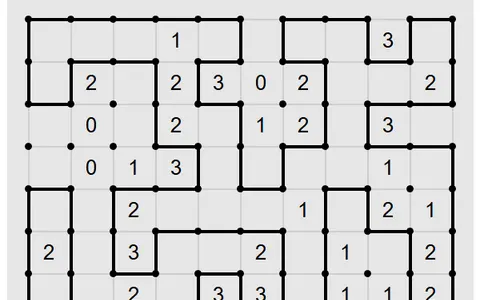
Exactly one loop must be drawn in this one, guided by numbers inside the cells, the reverse of avoiding loops.
 Galaxies Symmetry Puzzle
Rotational symmetry is the rule here, as you draw walls on a grid so every region matches itself when spun.
Questions
What is the rule about loops in Slant?
No set of diagonals may join into a closed shape, no matter how big. In a correct answer, every connected run of lines reaches the edge of the grid.
How do I play Slant Diagonals on a phone?
Tap a square to place a line, or press and hold for the other direction. A Tap switch below the grid lets you choose which slant a tap places first.
Are there different difficulty levels?
Yes. The Type menu has 5x5, 8x8 and 12x10 boards, each at Easy or Hard, and Custom lets you set your own size.
More like this: all puzzle games · every game A–Z